
Wednesday, October 21, 2015
Lissie Levitt Oral Law: You shall not render an unfair decision
I chose this because I think it is important to us to not judge a person by their skin color, financial status, sexual orientation, religion, and many more important characteristics of a person. I know my fellow class mates here about this organization Camp Jenny a lot, but I think I can say that the idea can be related. For those reading, Camp Jenny is a camp over memorial day weekend for elementry schoolers in inner city Atlanta all living in poverty. This camp encourages the students to work hard and have a positive attitude, and gives them opportunity for their future. The staff do not judge the campers based on the situation they come from and love the campers for their passion towards learning and gorgeous smiles.

The picture above is me and my camper Nikeria at Camp Jenny. It is so important for the world to give kids like her opportunity with out judgement, and I hope that this can help bring us one step closer to a little less hate toward people living with all different characteristics. I know we also recently had the tragedy in Charleston , in which a man came and took 9 lives because of his judgement toward African Americans, in which these 9 African Americans came to church that noght to study the bible, discuss it, just as we are now on this blog. I hope for a world and future with less judgement. We passed a law allowing Gay Marriage this summer. Two steps foward, one step back.

Ben Walton's Oral law assignment
I chose Leviticus 19, verse 4: "Do not turn to idols or make molten gods for yourselves: I the lord am your G-d." Learning from history we find that a lot of the time Jews were assimilating and loosing their religion as they turned towards foreign worship avodah zara. G-d made this law so no one would be tempted to turn away from their Judaism. Today even though there are not many pagans around I can still relate to this law. Today I would put into context of the modern age in America. I live in the U.S. today where there are many Christians. If you were to walk into a church today you would probably find a cross. I believe that the cross is a form of avodah zara because people depict G-d from the cross. I believe people are committing avodah zara in the same way with the tapestries in my synagogue. On the tapestries in my synagogue we have art depictions of biblical stories and other unkosher art.
This is a picture of a golden calf to represent the one that was made by the people at mount siani. I beleive this is amazing symbol of avodah zara because the people gave up on G-d at this moment. When Moses was on mount siani the people turned away from G-d cause they believed G-d had left them it was there were they started praying to a molten G-d which goes greatly against Leviticus 19, verse 4.
Ben Walton
Leviticus 19:29: was G-d a feminist?
I chose Leviticus 19:29 which reads "Do not degrade your daughter and make her a harlot, lest the land fall into harlotry and the land be filled with depravity."
This verse really speaks to me as a feminist. It does not allow slut-shaming, which is still incredibly relevant to our society today. If you do slut shame, or "make [your daughter] into a harlot," the verse continues, you will have cursed the land and filled it with prostitution and sin. (It is important to note that it is not the daughter that has cursed the land, but he who turns his daughter into a harlot.) This is an important message to send in modern times as the word "slut" is thrown around so casually and used so often. Though once in biblical times it was acceptable for a father to prositute his daughter, this verse encourages and requires respect. We must not judge any girl for her sexuality and we must not make the world wicked with the unrealistic amount of girls we call "sluts" and "whores."
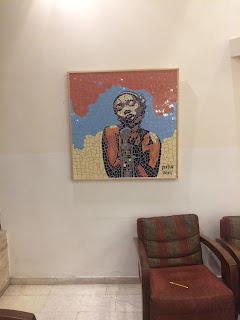
This verse really speaks to me as a feminist. It does not allow slut-shaming, which is still incredibly relevant to our society today. If you do slut shame, or "make [your daughter] into a harlot," the verse continues, you will have cursed the land and filled it with prostitution and sin. (It is important to note that it is not the daughter that has cursed the land, but he who turns his daughter into a harlot.) This is an important message to send in modern times as the word "slut" is thrown around so casually and used so often. Though once in biblical times it was acceptable for a father to prositute his daughter, this verse encourages and requires respect. We must not judge any girl for her sexuality and we must not make the world wicked with the unrealistic amount of girls we call "sluts" and "whores."
I have loved this mosaic since the first time I saw it in the Belmont. I think it beautifully embodies female beauty and expression. I interpret this picture as an African American woman singing in front of an audience. Since singers and those in the media now are often those that are slut shamed and judged by those that have never met them or those that are jealous, I thought this picture was extremely relevant to this commandment. The fact that she is black also ties in the extreme history of the American treatment of African Americans, from slavery to rape and all of the mistreatment in between. I think this woman embodies the ideal female expression and is a perfect example of the commandment, and I commend God for being the first feminist and for God's respect of the female body.
1.
Write
a concluding paragraph explaining how this photograph expresses the Jewish
mitzvah/ value you selected.
2.
This
assignment must be constructed of 2 paragraphs and a picture.
You shall not render an unfair decision: do not favor the poor or show
deference to the rich; judge your kinsmen fairly (Lev. 19:15)
I chose this mitzvah because of the massive contradictions between it
and the interpretation of the ideal in our own legal system in America. In the
United States we pride ourselves in the fact that “justice is blind,” but in
reality this couldn’t be further from the truth. Many of our judges pride
themselves on their strong Christian convictions, but they’re decisions don’t
reflect that. Why is that Laura Bush, former First Lady of the White House, can
run a stop sign and kill someone without an arrest, or Caitlyn Jenner can kill
someone in a car accident on the highway and not even face charges, but police
kill Eric Garner for selling loose cigarettes? This clearly is not “judg[ing]
your kinsmen fairly.” These cases are definitely showing “deference to the
rich” and have effects on all of us as American citizens. We live in that
country. The law is laid out fairly concisely—there isn’t much to change. The
issue is following it. If I had to build a fence around it, I would create
punishments for not living the mitzvah. Perhaps an unfair judge should be put
to trial for that crime, or be shamed and ostracized from the community.
Breaking this commandment has serious consequences on the entire community—from
the defendant, to his family, to everyone who relies on him in some way. While
as minors we aren’t part of the legal system, we can still fulfill this mitzvah
by doing what we do best—complaining. I write lengthy complaints to my school
community about this kind of injustice every month in our paper. When we are
able to vote, should we wish, we can choose our judges and our legislators.

This is the picture I chose to express this commandment. Here, George
Zimmerman, who was tried for the murder of Trayvon Martin in 2012, is acquitted
on Florida’s “stand your ground” laws, which dictate that allows people to use
deadly force to defend themselves. Zimmerman, on the neighborhood watch, had a
gun and Martin had a bag of skittles. This image shows the opposite of the
mitzvah. An injustice was carried out. By our laws, George Zimmerman should be
in prison; it’s a dark twist that he is not. Most obvious, our legal system
favors the rich and the white in our nation. This is a terrible crime in itself.
-Noah Arnold
Oral Law: Jacob
"You shall not make gashes in your flesh for the dead, or incise any marks on yourselves: I am the Lord." (Leviticus 19:28)
Oral Law surrounding this pasuk (building a fence):

Oral Law surrounding this pasuk (building a fence):
- When an individual dies, we are meant to honor and remember their lives; inflicting harm upon ourselves in this circumstance is to defile the beauty of life.
- Marks inflicted on oneself with malicious intent go against the word of God.
- Marks or piercings used to adorn one's body that are placed with benign intent are acceptable.
- Love yourself for you were made in the image of God; any self inflicted markings should be a reflection of this love.
I chose to interpret this verse as an admonishment against self harm. If all people are created in the image of God, b'tzelem elohim, then it is a horrible sin to commit acts of self harm. Theology aside, self harm is a very real problem that exists, and not necessarily for theological reasons. I believe that a person's soul is beautiful and thus, it should be loved, internally and externally, by the person, and by others. When an individual forgets their own beauty they may turn to self harm and having known people who have done this, this reality is horrible. All you want to do is help the people you love by teaching them to love themselves.
That aside, when marks such as tattoos or piercings are inflicted on the body, willingly that is, I believe it can be an expression of love for oneself and thus a positive thing. It could even make a person's connection to spirituality stronger. I want tattoos for personal reasons that are a reflection of the experiences that I have had, and these tattoos that I have envisioned as beautiful bracelets, are in Hebrew. As a Jew, even a Reform Jew, every time I bring this up, I find myself having to defend it. My parents are against the idea of me having tattoos because in their minds, it's not a very Jewish thing to do. When I told them I wanted them in Hebrew, I could see in their tight lipped responses telling me to think about it, that they thought I was being sacrilegious. My justification for the Hebrew is that Judaism is one of my core values and Jewish events have shaped my entire life. To decorate my body with Hebrew is one of the biggest mitzvot I can do because I love who I am and I love that God, or some higher power, has enabled me to be Jewish.

This is a photo of the Ahavah sculpture at the Israel Museum, where we have visited twice now. אהבה is one of the words that I want tattooed partly because I am basing my tattoos on the principle that they are an expression of love and partly because I want to always be reminded to come from a place of love, meaning that I want to come into every situation open minded and ready to be accepting. The expression of the concept of love, and in Hebrew no less, means an incredible amount to me as a Jew and I would love to wear it as an ornament for myself and for my Judaism.
Tuesday, October 20, 2015
תורה שבעל רמב"ל (רבן מיכה בירון לנט)
 |
| רבי יהודה הנשיא Tomb of |
תורה שבעל רמב"ל (רבן מיכה בירון לנט)
Chapter 1
Into the Tomb
Long ago, never mind precisely how long, a cave was discovered under the ruins of a great
ישיבה. But what was in this cave? What is this caves story?
Well it is learned from the archaeologists of old that this cave lies the body of רבי יהודה הנשיא and his descendants. He was the head of the סנהדרין, and he came after רבי עקיבה whom came after רבן גמליאל whom came after רבן יוחנן בן זכאי whom was the successor of הילל ושמאי. This man, buried here, was so great that after his inevitable demise, his own disciples built a place of learning, a ישיבה, over it. The new center of
 |
| Inside the tomb |
the סנהדרין where Judaic study would prosper for years to come. A place where the שישה סדרי משנה would be taught and learned in peace.
Sadly however, Judea was destroyed and now the people of Judea, the Jews, were a minority and the סנהדרין was in hiding. But that did not stop רבי יהודה taking the סנהדרין out of hiding and bringing it to a place of peace and beauty, בית שערים or The House of Measurements, where the tomb was found.
There was not only this tomb found at this site, but quite a few. Unfortunately, not all the other tombs were to be so modest as the tomb of רבי יהודה הנשיא. For there was tomb with despicable images (such as lions, eagles, and on one, the deity Nike) engraved on many sarcophagi. Although many of these images were carved only to symbolize the origin of the individual buried in each sarcophagus, it could still have been considered עבודה זרה. But why might it not have been considered עבודה זרה?
 |
| ציפורי |
Chapter 2
The Menological Mosaic
My Bird, or in laymen's terms, ציפורי, became the next great center of the סנהדרין. This new center was located on the top of a hill with surrounding valleys. The beauty of this site was alluring enough for any one to come, especially a Jew.
Now imagine, if this place was the center of the סנהדרין, then there must of been a בית כנסת. But what if this house of gathering had images. Images of people. Images of idolatrous works of art. Images that would- sorry, should- never be placed in a place of worship. Well if you are imagining this, then it should be apparent that this center of Jewish study, ציפורי, has one of theses horrendous mosaic floors.
On this floor, there are images of the very beginning of Judaism and the optimistic future of the Jewish culture. But in between these two sects of the one story, there was a calendar. A Greek calendar. And although there were these disgusting images in the synagogue there, through historical evidence, one can induce that people still prayed there. Now if the engraven images on the sarcophagi were bad enough, just imagine how bad this flooring was in ציפורי! And how can these images possibly be considered okay? At least the images in the tombs were in a place with no worship, but here, in the בית כנסת of ציפורי, is permitted? What the Gehenim??? How can it possibly be considered tolerable in the eyes of the Rabbis then? Would you make something like this in your synagogue?
The mosaic floor of the בית כנסת
Monday, October 19, 2015
This Sunday we were visited by Yasmin, Muslim woman who lives in the village below us, Ein Rafa. She converted when she was twenty eight. She originally came from a agnostic family from Britain. She has lead the lesson she taught us then for the past ten years, although generally we go to Ein Rafa for the tour. If we had went to Ein Rafa, the tour would have been led by both the Imam of the mosque, and Yasmin.
Yasmin gave us a brief history of Islam, which coincided with what we had learned in class that day. We went over the beginning of Islam through Mohammad, and how it spread after his death. We then thought of reasons of how the mass spread of Islam could be positive to Judaism.
Overall it was a very interesting lesson, and I just wanted to ask you, because we didn't have enough time to have all of our questions answered, what questions did you have that were not answered? Also, if we were able to have visited the mosque, what difference would you think it would have made?
Subscribe to:
Posts (Atom)