I chose the mitzvah from Leviticus 19:32, it says, "You shall rise before the aged and show deference to the old." I chose this mitzvah because it talks about paying respect to your elders, and that was always a very important value for me growing up. I interpret this mitzvah to mean that it is important to not only pay respects to your elders, but to visit them and listen to them. I fulfill this mitzvah in my life by doing my best to talk to my grandparents at least once a week, wether it is in person, on the phone, or through a letter or email. It can be a guideline in the modern world today because it is not only important to respect your elders, but it is important to listen and engage with them because they are your history, your ancestry, and you can learn a lot from them.
Pictured above, is me and my grandma on my mom's side. My grandmother is sweet and attentive and is always up for a puzzle some small talk or just hanging out. I love to talk with her about anything and everything. My grandpa is an author, so he alway has a good story to tell. When I was a kid I loved to listen to the children stories he wrote and now that I'm older I enjoy reading his adult literature and sending him my own writing to talk about. I love every minute spent with my grandparents, and it is especially important to maintain a strong connection with them not only because of how happy it makes me, but because of the joy it brings them.
Sunday, October 18, 2015
Oral Law Assignment: Daniella
“You shall not insult the deaf, or place a stumbling block before the blind. You shall fear your God: I am the Lord.” (Leviticus 19:14)
“Oral Law” Surrounding this Pasuk (building a fence around this verse)
- Respect people with disabilities, for they are also created b’tzelem elohim, in the image of Gd.
- Do not intentionally make more difficult that which is already difficult for a person.
- Accept the differences of those around you.
- Do not take personal ability for granted, or boast of it over others.
I chose to interpret this verse as not only referring to the deaf and blind, but to all disabled people. In addition, I took the “insult” and placing of the “stumbling block” as metaphors for a greater concept: one should respect both people who have disabilities and the challenges those disabilities present.
I chose this verse because I feel very strongly about the rights of people with disabilities, and about the ways in which they are treated. My older sister is severely disabled, and I have encountered the prejudice people bear towards the disabled merely because they may seem different on the surface. In my everyday life, I fulfill this commandment by trying to spend as much time with my older sister as possible, even when I fill my time with other commitments. The most important way I connect with my sister is through eye contact, because though she is not capable of speech or sign language, she can communicate so much through her eyes. My sister’s disability makes her slow to initiate eye contact, but spending the time to make that very simple, basic human connection with her is so important to me. Taking this time to connect with my sister consistently brings a smile to her face, because it is not something that most people who see her take the time to do. They think that because of her physical appearance, she must not have things to express or communicate. People who have this preconceived notions about my sister or any person with a physical disability are making an understandable mistake, but one that is based on prejudicial judgements that are due to appearance. I try to show respect for my sister by taking time to talk to her, and by making sustained eye contact with her, as much as possible. This shows a regard for her emotional and social needs that I feel many people ignore.
This photo is of my mom and my older sister during a family vacation. Most of the family had been paddleboarding, but my mom chose to stay in the shade with my sister, Naomi. This is a small and simple example of the sacrifices my parents make in order to respect Naomi’s needs. Although my mom would have loved to have been with the rest of the family doing a fun activity, Naomi’s needs and abilities are just as important as anyone else’s. In addition to showing respect for Naomi’s ability, the part of the verse that states “you shall not insult the deaf,” my parents do countless things every day in order to not “put a stumbling block” before Naomi; they do everything they can to make Naomi’s life dignified and pleasant.
Saturday, October 17, 2015
Oral Law Assignment
The mitzvah I chose is in verses 33 and 34, “When a stranger resides with you in your land, you shall not wrong him. The stranger who resides with you shall be to you as one of your citizens; you shall love him as yourself, for you were strangers in the land of Egypt: I the Lord am your God.” (Leviticus, 20.4, 19, 33-34) I interpret this mitzvah as a form of God saying that as Jews, we have to welcome and accept anyone that’s visiting our land. It’s our duty to be accepting and kind to anyone who is a stranger somewhere because we were once strangers in Egypt as well. In my daily life, I am thankful for this mitzvot every single day. Although it doesn’t feel like it, I am technically a stranger in Israel and I have always felt so welcomed and accepted here. It’s important to me that Israel feels like home, and it's because this mitzvah that has been achieved. EIE, family, friends, and everyone that I have stayed with in Israel have been more than welcoming and I could never shake the feeling that a huge part of that is because we all share being part of the Jewish community. Because of this, I will remember to always apply it to my life at home and as a modern Jew. The obvious application of this mitzvah in Israel has inspired me to always welcome someone who is new to my school or town. Even if that person isn’t Jewish, it’s an important value and mitzvah to have to be welcoming to anyone who is new and isn’t as familiar with everything as I am. Although it has changed in the sense that Jewish or not, I would generally not let any stranger just stay in my house, I will always remember to be as welcoming and kind as the people of Israel have been to me.
The picture I’ve chosen to express my mitzvah was taken at Tzuba, right outside on my balcony. I chose to take this and use it to symbolize my mitzvah because it serves as proof that I do have a home here, and I feel like I’m at home here. In the picture you can see the Judean Hills, the land that I’m a guest in. You can also see the flags that Tzuba has out right outside the lobby, American and Israeli. These flags are a message to me that I’m welcome here at the kibbutz and in this country. A couple of flags and the immense care of the staff and people here are enough to prove that the mitzvah is true, I am loved as a stranger that resides in somebody else’s home. Those are only two symbols of the mitzvah, along with all of the other times I have felt like I belong here in Israel.
Thursday, October 15, 2015
תורה שבעל פה Oral Law assignment
Due: Thursday, October 22
- Please open the Tanach to ויקרא י"ט (Leviticus 19). Please read the wide range of mitzvot here and choose one mitzvah (commandment) that you can relate to.
- Please explain why you chose this Mitzvah or pasuk (verse) and build a fence around it. How do you interpret this Mitzvah? How do you or can you fulfill this mitzvah in your daily life? How can it be a guideline for you as a Jew in the modern world?
- Using a digital camera, please take a photograph that in some way expresses the verse you selected. The photo can be a place, a person, something you’ve created, an object in nature, etc… Be creative! The image may only have meaning for you!
- Write a concluding paragraph explaining how this photograph expresses the Jewish mitzvah/ value you selected.
- This assignment must be constructed of 2 paragraphs and a picture.
Good luck & Enjoy!!!
Ariella
Is the Internet key to stopping attacks? HW for Sunday
Please read this article about the recent attacks and the social media and post a comment sharing your opinion on the matter.
Is the internet key to stopping the attacks? BY SIMONA WEINGLASS October 14, 2015
Tuesday, October 13, 2015
Is Google making us into electric sheeple?
Google
Hi Kitat Arava!
Happy to have rejoined your class. In these troubling days of news, thought I would change it up a bit and share with you a different type of article that I read on the Times of Israel. What do you think? Is Google turning us all into the same type of thinkers or is it making us better?
http://www.timesofisrael.com/is-google-making-us-into-electric-sheep/
Sunday, October 11, 2015
The Bar Kochva Revolt
Today we traveled across Israeli
scrub to a network of caves used during the Bar Kochva Revolt between 132-35
CE, where we learned about the last attempted revolution against foreign powers
until the end of the 19th century. Located in Chirbat Midras, or the
Ruins of Midras, we walked around stone ruins of public buildings and also saw
the nuf of new villages cropping around the landscape.
The reasons for the Bar Kochva
Revolt are disputed, but there are a few central theories. Christian sources (Eusebius
of Caesarea) point to the idea that the Jews had a false messianic fervor for
Simon Bar Kochva, who led the Jewish people at the time. Meanwhile, Roman
sources (Dio Cassius and Spartianus) instead propose that it was the result of
Caesar Hadrian building a temple to Jupiter on the ruins of Beit Hamikdash, or
because of a ban on circumcision, respectively. Last, Jewish texts assert that
Hadrian allowed the building of a third Beit Hamikdash, but only allowed treif
measurements for the building, generating anger from the Jewish community. Dio
Cassius’ claim is most widely believed today due to archaeological evidence and
greater inconsistencies in other theories.
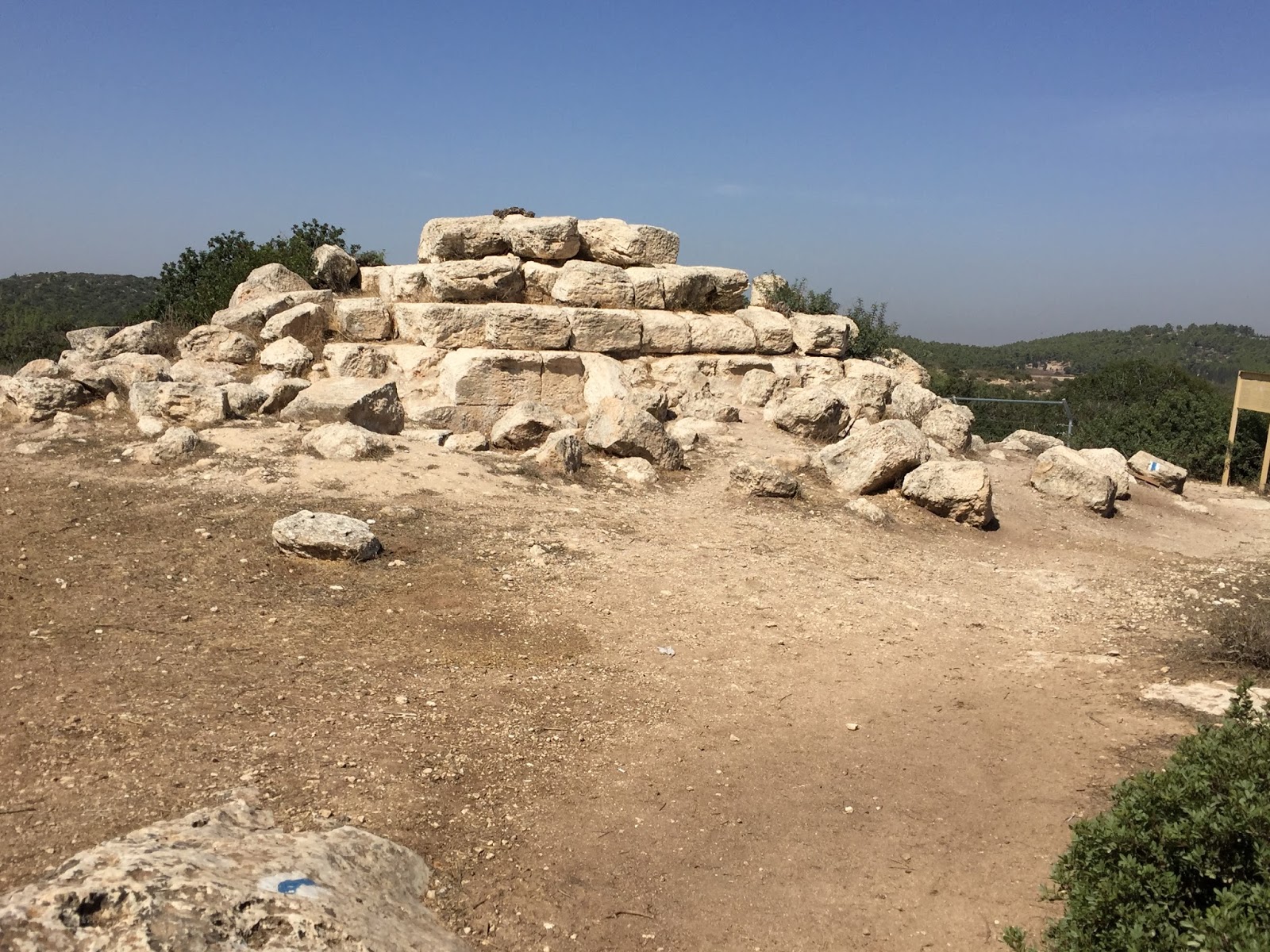
A tomb for someone of importance in Midras. Notice the small rocks placed on top of the structure, a Jewish custom of treating everyone in death equal. Instead of placing flowers or tokens, we place rocks.
There are a few major differences
between the Bar Kochva Revolt and the Great Revolt of 66 CE. The clearest is in
the unified leadership of the Bar Kochva Revolt, as opposed to the factions
that led the Great Revolt. Simon Bar Kochva was spearheaded by Reb Akiva and
widely accepted in Judea as the Messiah. Caves and supplies were prepared years
beforehand, showing the level of planning that went into the attempted revolt.
Jews even sabotaged Roman efforts by building subpar weaponry for them in the
years before and then using them themselves during the revolt.
Despite the better organization
and planning of the Bar Kochva Revolt, its aftermath was the final nail in the
coffin for Judea as a Jewish state until 1948. Roman legions destroyed 985
villages, killed roughly 580,000 Jews according to their records and banned the
practice of Judaism within the empire. Until Bar Kochva’s stronghold at Bitar
was destroyed on Tesha B’Av in 135 CE, he was seen as the Messiah, heralded by
Reb Akiva. After his defeat, for hundreds of years he was viewed as a false
messiah that led Judea to ruin. It wasn’t until Zionism developed that this
idea changed and the public opinion Bar Kochva changed, from someone who
brought ruin on the Jewish people to a defender (albeit failed one) against
foreign powers.
What I found most interesting about
this tiyul was the parallels between the Bar Kochva Revolt and insurgencies in
the ghettoes during the Shoah. The Jews of the Warsaw Ghetto, for instance,
utilized many of the same strategies as the Bar Kochva Jews, such as connecting
buildings together and blocking entrances, guerilla warfare and weapons
sabotage. It seems we’ve always been a hardy people. What do you think would
have been a better strategy, either diplomatically or defensively, against the
Romans? What would be your ultimate goal as a leader during the Revolt? Do you
see any other similarities between the Bar Kochva Revolt and other skirmishes
and wars of today?
Evan was right. The nuf is never enough
Subscribe to:
Posts (Atom)